
Finding Throughlines
Teach the big picture, not just the pieces.
Throughline (noun) — /thrü-līn/
A consistent theme, idea, or element that connects items in a series or parts of a whole.
Welcome to Finding Throughlines!
As educators, we often teach a series of individual concepts (fractions, ecosystems, revolutions, literary devices) without making the connections that reveal the bigger picture. Students may master each piece, but miss the story that ties them together.
Throughlines are the connective ideas that unify an instructional unit. They transform isolated lessons into a coherent journey while helping students understand, remember, and transfer learning with confidence. Establishing instructional throughlines strengthens student achievement by providing research‑supported gains in clarity, retention, transfer, and equity across learning experiences.
What Are "Finding Throughlines"?
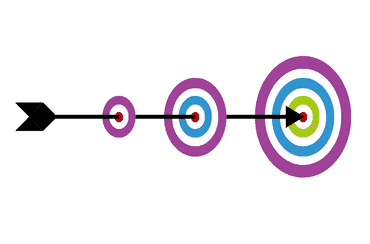
“Finding Throughlines” is an instructional activity that begins with four items (ideas, representations, or examples) and invites students to explore connections by selecting combinations of two, three, or all four. Finding throughlines is about constructing understanding, not just delivering content. It helps learners see the central idea that is part of a larger narrative, empowering them to make connections, transfer knowledge, and engage more deeply with learning. It’s about teaching why concepts matter, not just what they are. As learners engage, they progress through three levels of connection:
Levels of Connection
- Connection → Pairing two items based on a shared trait or relationship.
- Coherence → Grouping three items into a strand that reveals deeper structure or purpose.
- Throughline → Uniting all items with an overarching principle that binds them together.
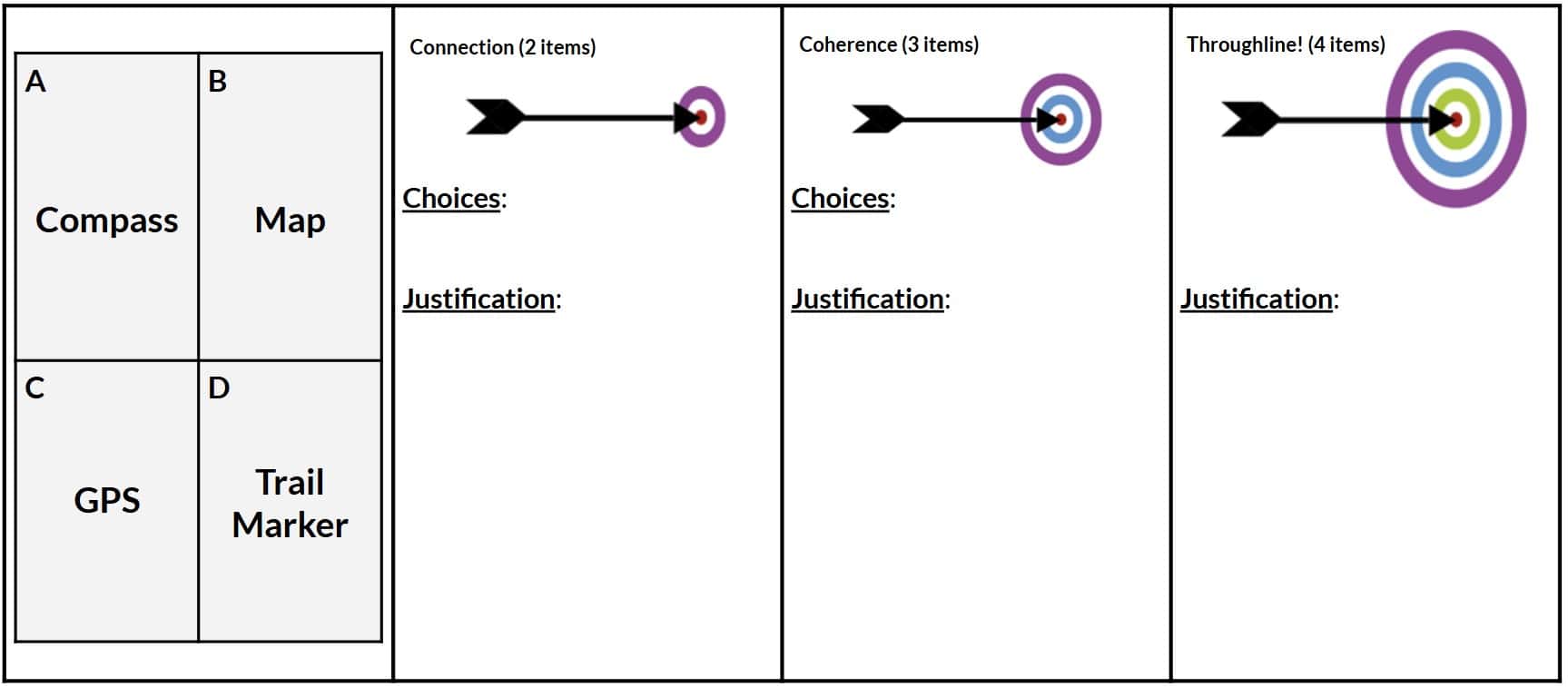
Let’s practice the process given this sample set of terms: Compass, Map, GPS, and Trail Marker. Use the recording sheet below to document your pairs, groups, and the reasoning behind your throughline. Take a moment to identify your connection, coherence, and throughline.
Use the following completed example as a guide for the depth of reasoning expected in justifications.
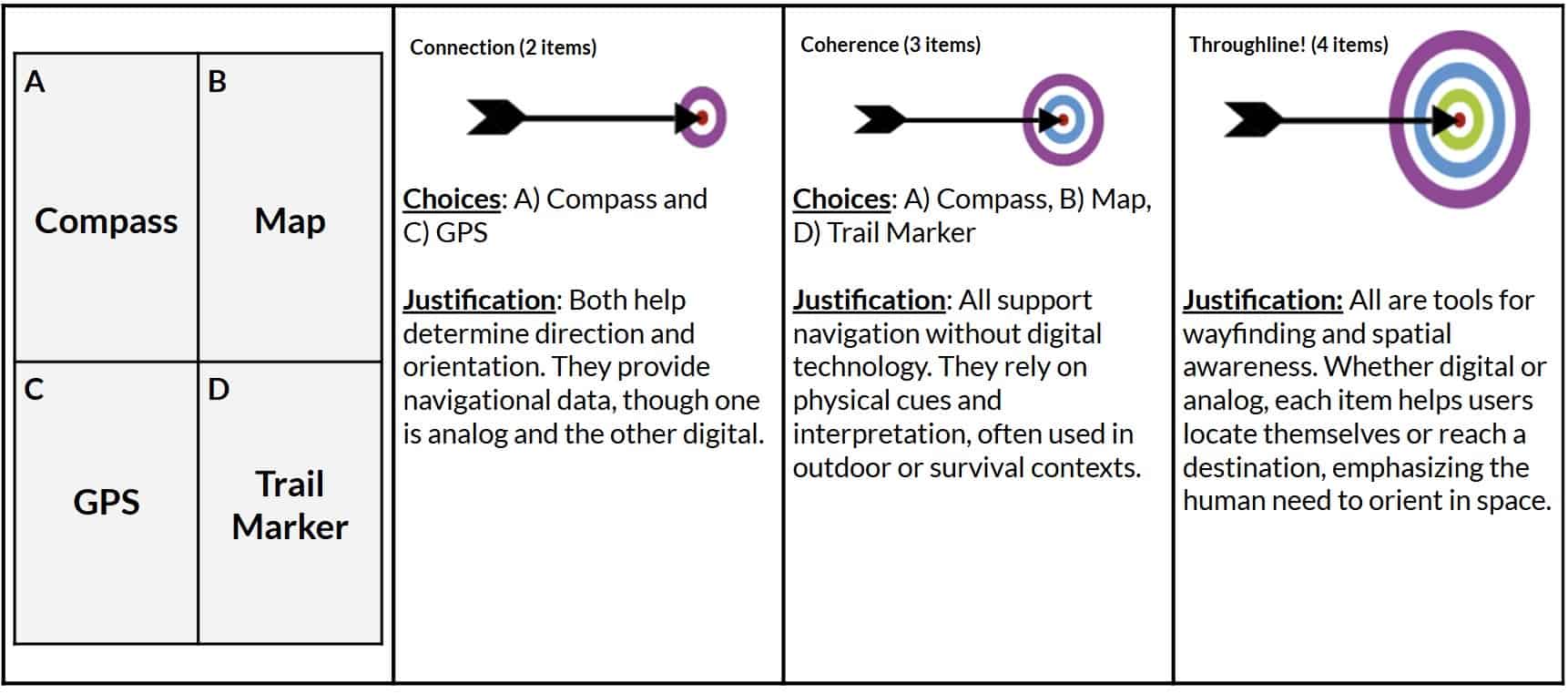
This layered approach encourages students to see beyond isolated facts and recognize the central theme or structure that gives meaning to an instructional unit, fostering clarity, coherence, and higher-order reasoning. It ties together individual lessons, so students see not just isolated concepts but the bigger picture of how those ideas fit into a coherent whole.
This progression moves students from noticing surface-level similarities to constructing higher-order reasoning and conceptual clarity.
Why Throughlines Matter
Too often, instructional units are taught as a series of disconnected lessons. Students may master each concept in isolation, but without a clear thread, they struggle to see how the pieces fit together. A throughline provides that thread, the connective idea that transforms lessons into a purposeful journey.
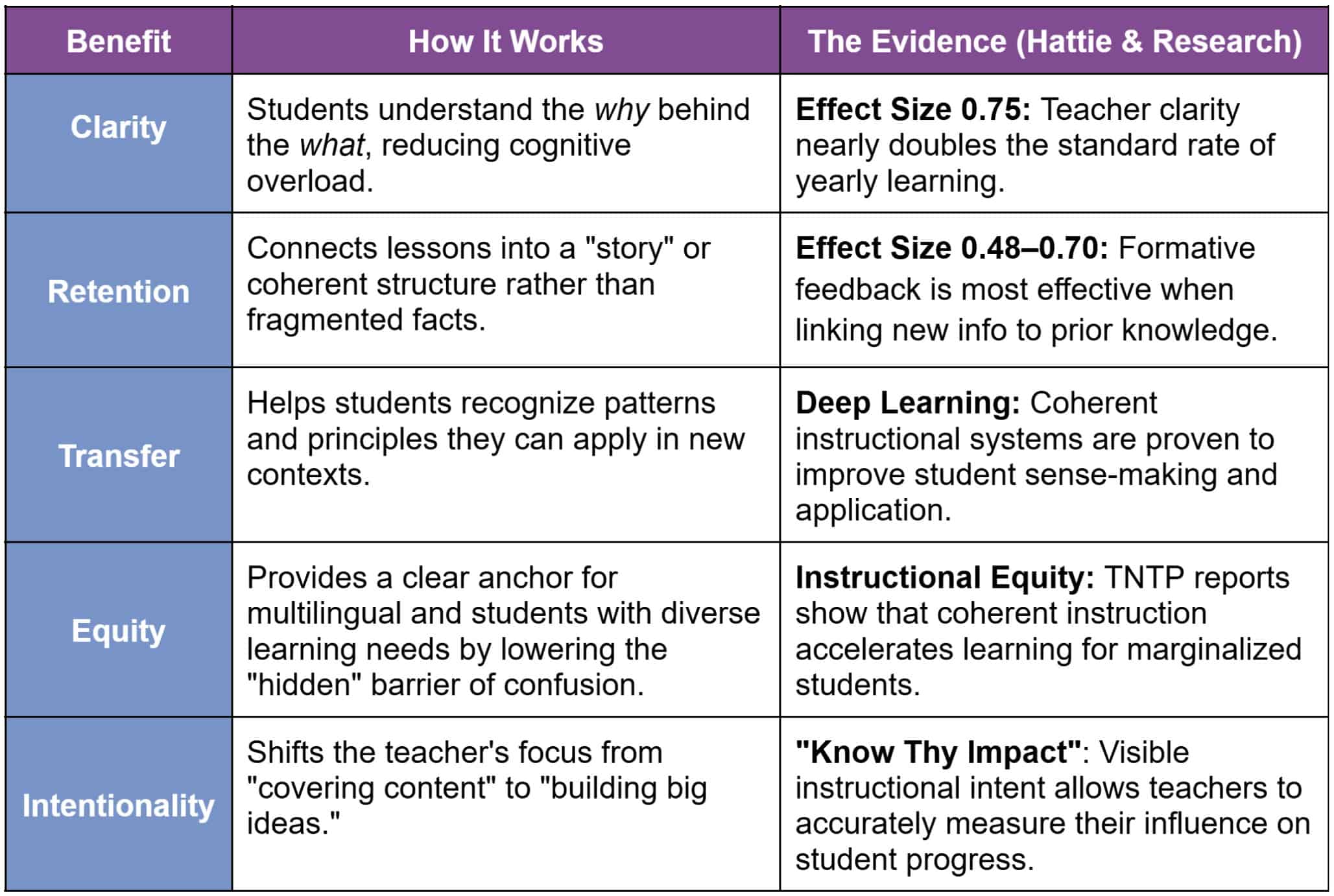
Research strongly supports the idea that instructional throughlines (clarity, coherence, and connected learning) improve student achievement. John Hattie’s Visible Learning meta-analyses and other studies on instructional coherence show that when teachers make connections explicit, students retain knowledge longer, transfer it more effectively, and experience greater equity in access to learning.
Finding Throughlines helps educators create learning that is purposeful, connected, memorable, and accessible for every student.
Here is a table aligning the core benefits with supporting research and educational impact.
What You Will Find Here
You’ll find everything you need to create your own Finding Throughlines activity. Our goal is to provide you with all the information needed to use these right away in classrooms or team planning.
Click on the links below to access resources!
- Examples: Cross‑disciplinary samples showing throughlines in math, science, history, language arts, and more. Return often as new Throughlines will be added to this slide deck.
- Variations and Activities: Variations and Activities: Specific activities based on the routine, such as the Card Draw Challenge, Build the Set, Gallery Walk, and the Throughlines Tournament.
- Downloads: Printables and templates for classroom and team use.
- Facilitation Guide (Contact Us!): Step‑by‑step protocols for professional learning sessions.
Closing Invitation
Finding throughlines is not about adding more work: it’s about teaching with purpose. Throughlines turn units into journeys of thought. They empower students to connect, question, and carry ideas beyond the classroom. When every lesson connects back to a bigger idea, students experience learning as a story they can carry forward. Explore the resources here, remix them for your context, and help learners see the story behind the standards.